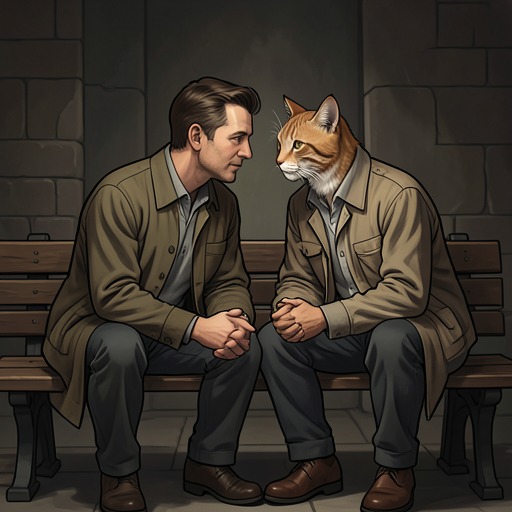
Elmer Elevator and his mother
My Father's DragonElmer Elevator’s conflict with his mother begins when he brings the Old Alley Cat into their household and becomes her friend. His mother’s rejection of the cat turns a small act of care into a direct household confrontation, and her punishment helps set Elmer on the path from secret defiance to leaving home to rescue the Baby Dragon.
A Household Divided Over the Cat
Elmer’s mother, who is also the narrator’s grandmother, objects to the Old Alley Cat because she hates cats, particularly old alley cats. When Elmer hopes the cat can have a saucer of milk, his mother refuses and argues that feeding one stray would mean having to feed every stray in town. Her objection is not presented as a negotiation: she makes clear that the cat will not be welcomed or supported in the home.
Elmer’s response is to continue caring for the cat without his mother’s permission. After apologizing for his mother’s rudeness, he tells the cat to stay and promises to bring her milk each day. For three weeks he feeds her, making their friendship depend on a quiet routine his mother does not know about. The saucer in the cellar eventually exposes that arrangement.
Discovery, Punishment, and Secret Loyalty
When Elmer’s mother finds the saucer, she becomes extremely angry. She whips Elmer and throws the cat out of the door, punishing both the boy’s disobedience and the animal he has tried to shelter. The scene makes the disagreement consequential: his mother does not merely forbid the feeding but uses force to end it and separate the friends.
Elmer nevertheless seeks the cat out later and meets her for a walk in the park. Their conversation turns to his wish to own an airplane and fly wherever he might choose. The episode shows that the punishment has not made him abandon either his friendship or his desire for freedom; after the cat asks how much he wants to fly, he says he would do anything for the chance.
From Domestic Conflict to the Rescue Journey
The cat answers Elmer’s longing for flight by telling him about the Baby Dragon on Wild Island. The young dragon has been tied by the animals and forced to carry passengers across a river; when he complains, they hurt him. The cat explains that she befriended him in secret and promised to help. Elmer accepts the rescue idea, and the narration explicitly connects his readiness to leave with his anger at his mother for having been rude to the cat: he does not feel sad about running away for a while.
That afternoon, Elmer and the cat go to the docks to find out when a ship will sail to the Island of Tangerina. The cat helps him plan and shares what she knows about Wild Island, though she is too old to accompany him. They keep their preparations secret, hiding supplies behind a rock in the park; the night before sailing, Elmer borrows his father’s knapsack and packs with the cat. The mother–son conflict thus has a practical consequence beyond the broken household rule: Elmer’s loyalty to the cat becomes part of the chain of events that carries him away from home and toward the Baby Dragon’s rescue. His later effort to saw through the rope binding the dragon gives that earlier defiance a wider shape: he acts against the confinement of another vulnerable creature after refusing to accept his mother’s rejection of the cat.